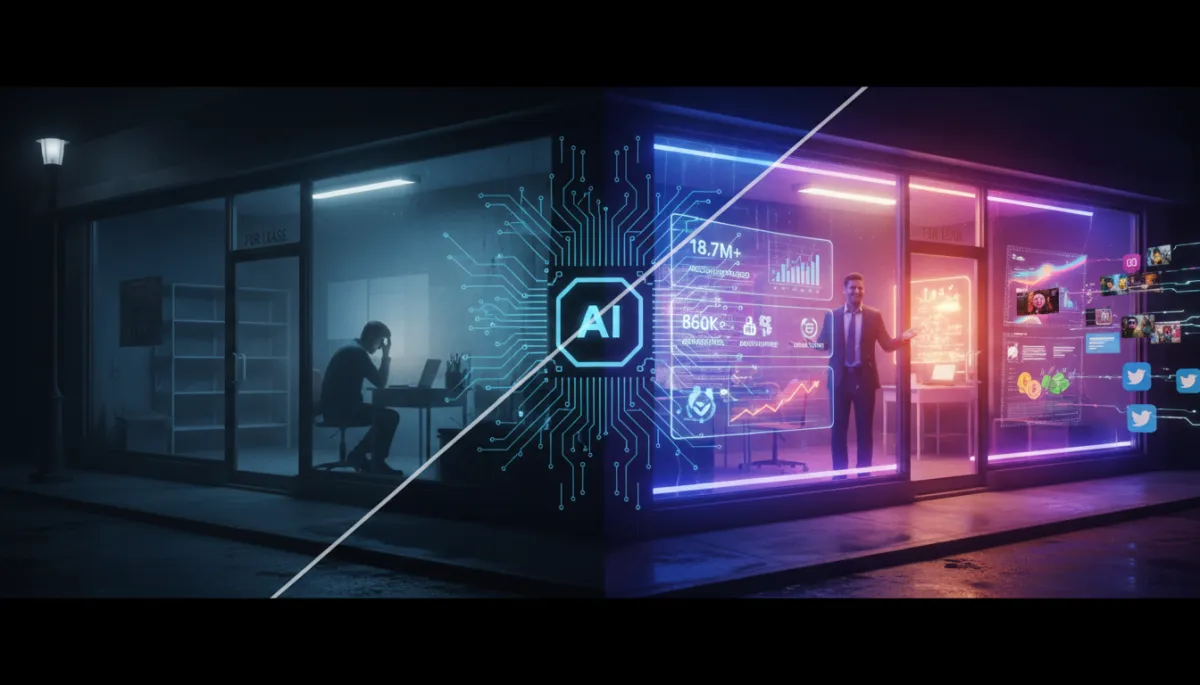
Two Business Owners. Same City. Same Skills. One Is Printing Money. One Just Quit.
AI content automation, Local business, AI Employers, app.robopimp.ai
Two Business Owners. Same City. Same Skills. One Is Printing Money. One Just Quit.
Two local service businesses. Same streets, same economy, same platforms. Six months later, one is quietly printing money with AI content automation, and the other just walked away from social media saying, “It doesn’t work for my business.” Real talk: the only variable was the system they chose to run.
This story is about two people you know. Different names, different storefronts, but you’ve seen this movie play out in your own city, fr fr. Two owners open up shop, do solid work, collect a few reviews, and start posting on social. Six months later, one is booked out with a waitlist, and the other is wondering if they should dust off their résumé.
The difference isn’t talent. It’s not timing. It’s not even ad budget. In 2026, when AI content automation is standard infrastructure, the gap is one decision about how you run your content system. One of them plugged into AI content automation AI Employers at app.robopimp.ai. The other stayed manual, lowkey hoping “being consistent” would be enough. No cap, that’s the fork in the road.
Meet Marcus and Dre. Same city. Same lane. Both run local service businesses — think towing, HVAC, mobile detailing, barbershop, pick your archetype. They both have decent reviews, word-of-mouth referrals, and enough skill to keep a client once they land one. Neither came from money. Neither had a big marketing budget. Both knew they “should post more content,” and both were already stretched thin just keeping the lights on.
Six months ago, they were in the exact same position. Then Marcus got introduced to AI Employers, the automated content creation AI and operations stack at app.robopimp.ai content automation. Dre didn’t. What happened next is the Wall Street Journal “two young men” story updated for video clipping AI 2026, local algorithms, and AI agents that never sleep.
[ MARCUS — MONTH ONE ]
Marcus makes one decision: “If I’m going to do this content thing, I’m not doing it the slow way.” He blocks off 20 minutes on a Tuesday night. No studio, no fancy mic, just his phone, a ring light, and the knowledge already in his head. He hits record and talks through the top five questions customers always ask, plus one quick story about a client he helped last week. Raw, honest, lowkey funny. Then he uploads that single 20‑minute video into the AI content automation AI Employers pipeline at app.robopimp.ai.
Behind the scenes, the video clipping engine — the same class of video clipping AI 2026 tools that are now standard across enterprise marketing — goes to work. The system parses the transcript, scores segments by hook strength, retention potential, and keyword density. It flags the eight best moments automatically. No dragging timelines, no guessing which part will hit. The AI content clipping local business workflow slices each highlight, adds burned-in captions, and formats everything for Reels, TikTok, Shorts, and Facebook vertical. One video becomes 30+ pieces of content with AI clipping, on sight.
Before this, Marcus was posting maybe twice a week, on a good week. Like most owners, he’s juggling jobs, invoices, and family. A human running a business can realistically post 1–3 times per week maximum. The system doesn’t get tired. It schedules, recycles, and cross‑posts 24/7. Within days, Marcus goes from “I should post more” to “I’m everywhere,” without hiring an editor, a social media manager, or an agency. Real talk, the game just changed for him, even if the city hasn’t noticed yet.
[ DRE — MONTH ONE ]
Dre is just as serious about his craft. He’s proud of his work, and his customers love him. He also decides it’s time to “get serious” about content. So he does what most owners do: he records a video on Saturday. Then he spends his Sunday afternoon in a free editing app, trying to cut it down, add captions, and make it look like what he sees on Instagram Explore. It takes him hours. By Monday, he posts one clip to Instagram and one to Facebook. It does okay — a few likes, a couple of comments, no real spike in leads.
Dre tells himself, “Next month I’ll be more consistent.” He’s been saying that for six months. There’s no system, no automation, no AI social media automation 2026 stack behind him. Just willpower and whatever time is left after a 60‑hour week. On paper, Dre and Marcus have the same skill, the same market, and the same platforms. But under the hood, Marcus now has a content infrastructure. Dre has a to‑do list.
[ MARCUS — MONTH THREE ]
By month three, Marcus’s city has started to notice. His face is popping up in Reels, Shorts, TikToks, and Facebook feeds. People who have never met him feel like they’ve known him for months. That’s the compound effect of automated content creation AI running 24/7. Every time he records a fresh 20‑minute session, AI Employers turns it into another wave of micro‑content, quotes, carousels, and clips. The system reuses what works, tests different hooks, and keeps his brand in circulation without him pushing the buttons manually.
Now the DMs start hitting. Instagram messages. Facebook inbox. Website chat. In a manual world, this is where most owners choke — they simply can’t keep up. Marcus does something different. He adds Conversational AI from AI Employers to his stack. Every DM, every comment that signals interest, every “How much do you charge?” is routed through the AI agents. They respond instantly, 24/7, with pre‑trained, on‑brand answers, and they push people toward his booking link. What used to be random messages now flow through a structured pipeline — inquiry, qualify, book, confirm.
Across the platform, this infrastructure has already pushed 18.7M+ messages, handled 14.7M+ calls, and booked 860K+ appointments. That’s not theory; that’s scale. Marcus is now tapping into the same AI backbone that enterprise teams use, but pointed at his local market. Where a human owner might reply to a handful of DMs at night, the system can handle hundreds of conversations concurrently, never losing a lead. Businesses running this kind of AI content automation AI Employers stack are seeing 3–5x more reach per content dollar spent, because every piece of content is connected to a follow‑up engine that actually converts attention into appointments.
[ DRE — MONTH THREE ]
Dre is tired. He’s still trying to do it the old way. Film on Saturday, edit on Sunday, post on Monday, promise himself he’ll do it again next week. But life keeps happening. A truck breaks down. A customer reschedules. A kid gets sick. Suddenly, two weeks go by with no posts. When he does finally upload, the algorithm treats it like a stranger walking into the room — no momentum, no built‑in audience memory, no compounding. His DMs are a mess. Some people asked for quotes two weeks ago and never got a reply. A few hot leads just went cold because he saw the message too late. He missed three real opportunities this week alone, and he knows it.
Meanwhile, he keeps seeing Marcus’s content. Same city, same niche, maybe even overlapping service area. Marcus is showing up on his feed, on his cousin’s feed, on his customers’ feeds. Dre starts telling himself, “The algorithm just hates me.” It doesn’t. Algorithms in 2026 are brutally simple: they reward consistent, engaging, multi‑format output. Marcus has AI social media automation 2026 agents pushing content, testing variants, and keeping his presence live. Dre is going 1v100 against a system that was never built for humans to fight alone. He’s not out‑talented; he’s outgunned.
[ MARCUS — MONTH SIX ]
By month six, the split between Marcus and Dre looks like two different realities — just like that storefront split in the hero image. Marcus sits down once a week, sometimes once every two weeks, records his 20–30 minutes of raw content, and feeds the machine. The rest is handled by app.robopimp.ai content automation. The platform tracks the cumulative workload off his plate: 64,000+ hours saved across users, the equivalent of entire teams of editors, schedulers, and appointment setters he never had to hire. His monthly revenue is up, his ad spend is flat, and his stress is down. That’s not motivation; that’s math.
Marcus doesn’t have a “social media team.” He has a system. The same system that has already contributed to a documented $27M+ revenue uplift across the network. The Conversational AI that answered his DMs is the same class of agent that has handled 14.7M+ calls and 18.7M+ messages for other businesses. The appointment engine that fills his calendar is part of the same framework that’s already booked 860K+ appointments. When he looks at his dashboard, he’s not guessing. He sees structured data: impressions, clicks, replies, bookings, and revenue tied back to specific content runs. This is instrumented marketing, not vibes and hope.
[ DRE — MONTH SIX ]
Dre has quietly stopped posting. Last month, after another stretch of inconsistency, he told a friend, “Social media doesn’t work for my business.” That’s the line you hear from owners who never had a real system in place. He’s back to relying on word‑of‑mouth and the occasional Google Maps lead. He’s not lazy. He’s not dumb. He’s just trying to run a 2026 business with a 2016 playbook, manually editing videos on a cracked iPhone while his competitors deploy Bison Vazquez content AI frameworks and AI content automation AI Employers agents that operate like digital coworkers.
— FOLLOW THE CONTENT JOURNEY —
@aiemployers
Daily clips. Real business. Real results. Like & comment for more 🔥
FOLLOW NOW[ THE REVEAL — SAME CITY, SAME SKILLS, DIFFERENT SYSTEM ]
The difference between Marcus and Dre was $0. Not budget. Not talent. Not even raw time. Both of them had 24 hours in a day, family obligations, and a business to run. The divergence came from one decision: Marcus deployed AI content automation AI Employers through app.robopimp.ai. Dre didn’t. That’s it. That’s the whole plot twist. In a market where, according to current research, 38% of business web content is already AI‑assisted and 85%+ of marketers are using AI in their workflows, staying manual is not neutral; it’s falling behind.
Here’s what Marcus actually turned on — the same stack you can access:
- AI clipping & repurposing. One long‑form video in, 30+ assets out. Vertical clips, square posts, quotes, carousels — all generated by video clipping AI 2026 tuned for local discovery. This is the AI content clipping local business engine that makes one good session work like a month of manual editing.
- Conversational AI for DMs & comments. Every DM, comment, and inquiry gets an instant, context‑aware response. No more “Sorry, just saw this.” The same class of agents that have processed 18.7M+ messages and 14.7M+ calls handle his pipeline on autopilot.
- Booking automation. Leads are guided from interest to booked appointment without Marcus touching a keyboard. That’s how the system contributes to 860K+ appointments booked and $27M+ revenue uplift across businesses using the stack.
- Always‑on distribution. The AI social media automation 2026 layer keeps content cycling, re‑posting winners, and testing new hooks. Remember: a human owner can post 1–3 times per week at best. The AI posts daily, sometimes multiple times per day, across every platform, without complaining or burning out.
This is the playbook Bison Vazquez content AI breaks down on YouTube and inside the AI Employers ecosystem. It’s not “get lucky with the algorithm.” It’s build a repeatable, data‑driven content pipeline that turns your expertise into a constant stream of discoverable, bookable demand. Businesses that implement this kind of automated content creation AI see 3–5x more reach per content dollar spent, because they’re not paying for one‑off posts; they’re investing in a system that compounds.
[ WHICH ONE ARE YOU? ]
Right now, in your city, there’s a Marcus and there’s a Dre. Maybe you already know them. Maybe, lowkey, you are one of them. One is quietly building an unfair advantage with a content and communication stack that never sleeps. The other is still editing in their Notes app at midnight, telling themselves they’ll “start fresh next month.” Real talk: this is the part of the documentary where the narrator looks straight into the camera and asks you a question.
Which one are you going to be, six months from now? The owner who decided to run with a proven AI content automation AI Employers system, or the owner who decided to keep doing everything by hand and hope it works out? You don’t control the algorithm. You don’t control the economy. But you do control whether you plug your business into infrastructure that has already saved 64,000+ hours of manual work and generated tens of millions in trackable revenue uplift.
There’s only one question left: What system are you running? If your current answer is “me and my phone,” that’s not a system. That’s a bottleneck. The invitation is simple and direct: go to app.robopimp.ai, see the stack, and deploy the same AI content automation framework Marcus used. Not someday. Not “when things slow down.” Now — while your competitors are still telling themselves they’ll be more consistent next month, no cap.
THE REAL-WORLD MARCUS
DYB Towing LLC — AI Automation Live on Facebook
A real local business running the full AI stack. No theory. Follow and watch the game being played in real time.
Like & comment — you're helping the algorithm find the next Marcus 🙏
"The only variable was the system. app.robopimp.ai — be the Marcus."
